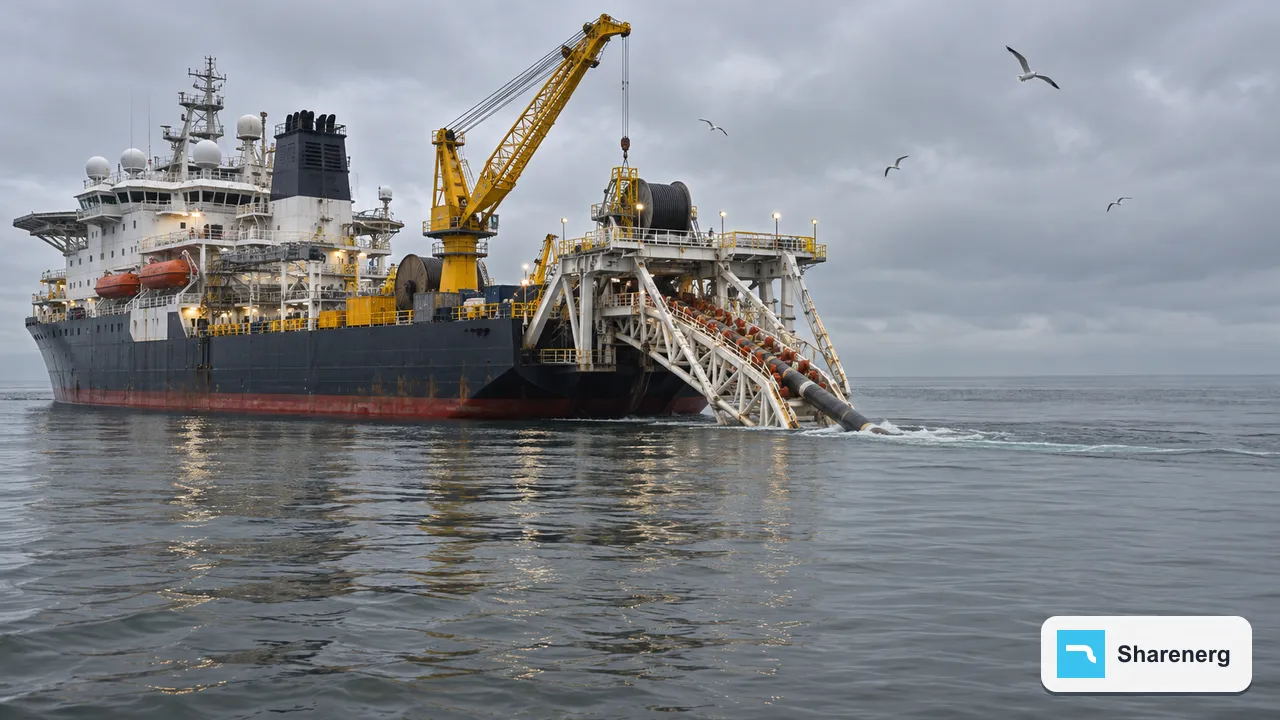
The Northern Endurance Partnership (NEP) began its offshore construction campaign at the Port of Hartlepool in July 2026. The main element is a 149 km, 28-inch pipeline that will carry captured CO2 from Teesside to the Endurance saline aquifer under the southern North Sea. Around 12,000 concrete-coated linepipe joints are involved, most of them made in Hartlepool. Start-up is planned for 2028.
What NEP is
NEP is the transport and storage part of the East Coast Cluster. When the partners took the final investment decision in December 2024, Offshore magazine reported that bp and Equinor each held 45% and TotalEnergies 10%. The store is the Endurance saline aquifer, about 1,000 m below the seabed and 75 km east of Flamborough Head. Initial capacity is up to 4 million tonnes of CO2 a year from three Teesside projects, with an average of up to 23 million tonnes a year targeted by 2035 as the cluster grows.
The first emitter expected to connect is Net Zero Teesside Power, a gas-fired power station with carbon capture of up to 742 MW. The onshore scope includes a CO2 gathering network and compression, while offshore it includes the export pipeline and subsea injection and monitoring facilities.
The offshore campaign
PD Ports announced on 23 July 2026 that linepipe had arrived at the Saipem logistics facility in Hartlepool, marking the start of the offshore programme. Saipem is building the 149 km, 28-inch pipeline and its landfall. The numbers give a sense of scale:
- about 12,000 concrete-coated joints, weighing about 170,000 tonnes in total;
- more than 60% of the joints made at the former Liberty Steel pipe mill in Hartlepool, now operated by Corinth Pipeworks;
- more than £1 million invested in pipe handling equipment at the port;
- the project reported as around one-third complete at that point.
Earlier coverage gave the offshore line as about 145 km. The 149 km figure is the one used in the July 2026 announcement, which describes the pipeline together with its associated landfall.
Why concrete-coated pipe
Concrete weight coating gives the pipeline the submerged weight it needs to stay put on the seabed under wave and current loading. The southern North Sea is shallow, and in shallow water waves reach the seabed with real force, especially near the coast. Our article on on-bottom stability covers the design checks and the alternatives, such as trenching and rock placement.
Coated joints are heavy and awkward to handle. Ports need suitable quayside space, cranes and stacking arrangements that avoid damage to the concrete or the anti-corrosion coating beneath it. Field joints, where two lengths are welded together on the lay vessel, need their own infill coating so that weight and corrosion protection are continuous along the line.
The landfall
The point where an offshore pipeline comes ashore is usually the most constrained part of the route. Beaches, dunes, sea defences and protected coastal habitats all sit within a short distance, and the nearshore zone sees the strongest wave action. Pipelines are commonly pulled ashore through a trench or a drilled bore under the shoreline, and the choice depends on ground conditions, coastal erosion and environmental limits on working in the intertidal zone. Whatever the method, the landfall has to be built in a weather window and tied in to the offshore line with minimal delay, which makes it a frequent source of schedule risk on projects of this kind.
Designed for CO2 from the start
Unlike HyNet, which uses an existing pipeline for part of its route, NEP's offshore line is new build and designed for CO2 from day one. That allows the designers to choose steel grade, wall thickness, toughness and fracture arrestors with CO2 in mind, rather than working within the limits of an existing gas line. CO2 pipelines need particular attention to:
- Running ductile fracture. Decompression behaviour of CO2 can sustain a running crack in a way natural gas usually cannot, so toughness requirements and crack arrestors are set accordingly.
- Water content. Free water in CO2 forms carbonic acid, which is highly corrosive to carbon steel. Dehydration and composition specifications at the entry point are critical.
- Impurities. Captured CO2 carries traces of other gases from the source process, which shift phase boundaries and can affect materials.
These issues are explained further in our article on designing CO2 pipelines for carbon capture.
Local supply chain and jobs
The Hartlepool mill matters for the local economy as well as the schedule. PD Ports said the mill supports around 150 skilled jobs plus 35 further roles. NEP's first progress and impact report, covered by World Pipelines on 15 October 2026, says more than £2.1 billion of contracts have been awarded to UK suppliers so far, with 300 UK subcontracts and more than half of supply chain content sourced in the UK. NEP and Net Zero Teesside Power together are expected to sustain more than 3,000 jobs through construction.
From January 2027, imported steel pipe will also attract the UK's carbon border charge, which may change the economics of sourcing for future CO2 and hydrogen lines. See our guide to UK CBAM and line pipe imports.
What comes next: the Humber
NEP is designed to grow. The same October report looks ahead to a Humber CCS pipeline, which it says could contribute about £3 billion of gross value added during construction and support around 1,800 full-time equivalent jobs a year once operating. That expansion would bring industrial emitters around the Humber into the same transport and storage system.
For now, the immediate engineering milestones are offshore pipelay, the landfall, subsea injection facilities and the onshore gathering network and compression on Teesside. With HyNet in the north-west following a similar timetable, 2028 is shaping up as the year the UK's first CO2 transport networks start operating. Our companion piece on HyNet's CO2 pipeline construction looks at the other Track-1 cluster.