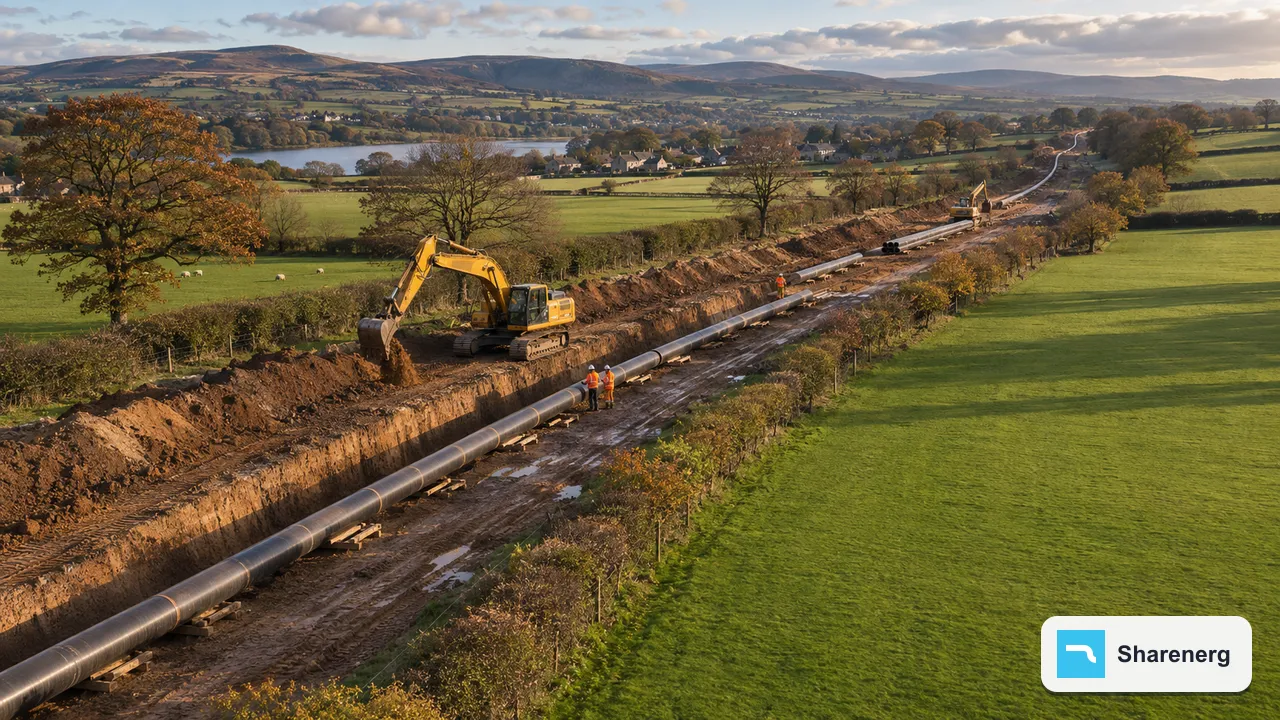
HyNet's carbon dioxide pipeline in Cheshire and North Wales is now well into construction. At the HyNet conference in March 2026, the transport and storage project was estimated to be about 25% complete, with operational readiness planned for late 2028. The onshore main line alone involves 772 crossings, 55 of them trenchless. This article looks at how the system is put together and what makes it a demanding build.
The system in outline
HyNet's transport and storage network, known as Liverpool Bay CCS and led by Eni, will collect CO2 from industrial sites around Ince and Stanlow, move it west to the Point of Ayr terminal in Flintshire, and then send it offshore for storage in depleted gas fields beneath Liverpool Bay. The Chemical Engineer reported in March 2024, when the onshore pipeline was approved, that it comprised around 60 km of pipeline:
- a new 4 km underground section of 20-inch pipe between Ince and Stanlow, sized for 2.5 million tonnes of CO2 a year at around 38 barg;
- a new 32 km section of 36-inch pipe from Stanlow towards Flint, sized for 10 million tonnes a year at up to 35 barg;
- an existing 24 km natural gas pipeline that will be repurposed to carry CO2 onwards to the Point of Ayr.
Eni's project page names the storage reservoirs as the depleted Hamilton, Hamilton North and Lennox fields, with storage potential of 4.5 million tonnes a year in the first phase and 10 million tonnes a year after 2030. The project reached financial close in April 2025. The first emitters are expected to be cement manufacturing, low-carbon hydrogen production and energy from waste.
Who is building what
HyNet has confirmed three main contractors:
- United Living is building the onshore carbon capture pipeline.
- Rosetti Marino is delivering four platforms for CO2 storage in the depleted reservoirs.
- Saipem will construct and commission the Point of Ayr compression station, which links the onshore and offshore parts of the system.
At the March 2026 conference, the project also reported that a new offshore platform, the Douglas Hub, was under construction, with installation planned for later in 2026. Three depleted gas fields and one existing offshore pipeline are being repurposed.
Why 772 crossings matter
Crossings are where a pipeline meets everything else: roads, railways, rivers, canals, drainage ditches, hedgerows, field boundaries and other buried services. On a corridor running through industrial Cheshire and into North Wales, they come thick and fast. Each one has its own design, consent conditions and construction method.
Open-cut crossings
Most of the 772 will be open-cut, where the trench simply continues across the obstacle with temporary diversions, flumes for small watercourses or reinstatement of field drains. These are routine but still need careful sequencing, especially on farmland where drainage repairs and soil handling are agreed with landowners in advance.
Trenchless "complex" crossings
The 55 trenchless crossings are where open cutting is not acceptable or not practical, typically major roads, railways, larger rivers and sensitive habitats. Methods include auger boring, pipe jacking, microtunnelling and horizontal directional drilling (HDD). Each brings its own engineering:
- Ground investigation. Trenchless methods are sensitive to boulders, gravel lenses, made ground and high groundwater. Industrial land near the Mersey estuary can contain all of these.
- Pipe stress. For HDD, the pullback load, bending radius and external pressure from drilling fluid all have to be checked on a large-diameter, heavy-wall pipe.
- Coating protection. Coatings are abraded as pipe is pulled through the bore, so abrasion-resistant overlays and post-installation surveys are common.
- Frac-out risk. Drilling fluid can escape to the surface or into watercourses if the ground cannot contain the pressure, so monitoring plans are needed near rivers.
Route selection decides how many of these crossings a project takes on. Our article on GIS-led route selection for onshore pipelines explains how constraint mapping is used to balance length, crossings and environmental impact.
Dense phase CO2 and the design pressure
The quoted operating pressures of around 35 to 38 barg for the onshore sections are low compared with many dense phase CO2 pipelines. At those pressures and ground temperatures, CO2 is transported as a gas onshore and compressed at the Point of Ayr for the offshore leg. Gas-phase transport simplifies some issues, such as the risk of running ductile fracture associated with high-pressure dense phase lines, but it requires larger diameters for the same mass flow, which is one reason the main onshore line is 36 inches.
Our earlier article on designing CO2 pipelines for carbon capture goes through phase behaviour, impurities and fracture control in more detail.
Repurposing the existing gas line
The 24 km existing natural gas pipeline that completes the onshore route raises a different set of questions. Before an existing line can carry CO2, engineers need to confirm its material properties, wall thickness and condition from inspection data, check that it can handle CO2 with the expected impurities and water content, and review valves, seals and fittings for compatibility. Isolation, purging and commissioning are planned so that natural gas and CO2 are never mixed in the line. Many of the same steps apply to hydrogen conversion, which we discuss in our article on repurposing gas pipelines for hydrogen.
Looking ahead to 2028
The project's timeline aims for operational readiness in late 2028, reaching 4.5 million tonnes a year by 2030 and potentially 10 million tonnes a year by 2035. The remaining work includes completing the onshore pipeline and its trenchless crossings, building the Point of Ayr compression station, installing the Douglas Hub Platform and converting the offshore reservoirs and pipeline for injection.
The emitters must also finish their capture plants on time, since a pipeline without CO2 to carry earns nothing. For engineers watching the UK's first CCS clusters, HyNet and the Northern Endurance Partnership on Teesside are the two projects that will show whether the UK can deliver CO2 networks to programme.