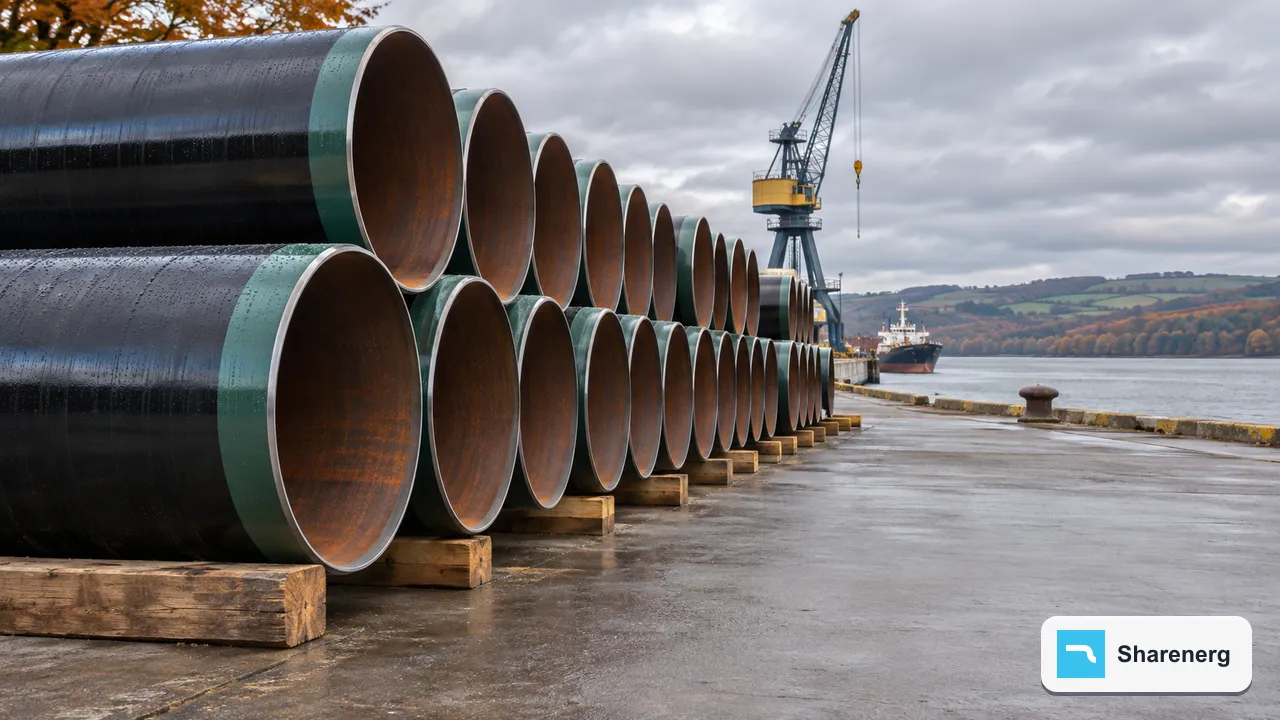
From 1 January 2027 the UK Carbon Border Adjustment Mechanism (CBAM) puts a carbon charge on imported iron and steel, and that includes seamless and welded line pipe and pipe fittings. If your company imports pipe, bends, flanges or fittings for a pipeline project, you may be the person liable. The first annual return and payment are not due until 31 May 2028, but the emissions data you need has to be gathered for every shipment that lands from New Year's Day onwards.
Which pipeline products are caught
HMRC's CBAM policy summary, last updated on 2 November 2026, lists the commodity codes in scope. Five sectors are covered: aluminium, cement, fertiliser, hydrogen, and iron and steel. For people who buy pipe, the important headings in the annex are:
- 7304: seamless tubes and pipes of iron or steel, which covers most seamless line pipe, casing and tubing.
- 7305: welded pipes with an external diameter above 406.4 mm, the heading for most large-diameter SAW line pipe used on transmission and offshore lines.
- 7306: other welded tubes and pipes, which takes in smaller ERW sizes.
- 7307: tube and pipe fittings such as elbows, tees, reducers and flanges.
Coverage is decided by the commodity code on the customs declaration, so the classification your broker uses matters as much as the product description on the mill certificate. Ferrous scrap under heading 7204 is excluded.
Who actually pays
The person liable is the importer of the CBAM goods. In practice that means the importer named on the customs declaration, even when a freight forwarder or customs agent files the paperwork. On a typical pipeline job the importer could be the operator, the EPC contractor, a pipe stockist or the mill's UK sales company, depending on the Incoterms in the purchase order. It is worth settling that point in contracts now, because a DDP delivery from an overseas mill can leave the mill's UK entity carrying the liability, while an EXW or FCA purchase usually lands it on the buyer.
There is a de minimis rule. Registration is only required once the value of CBAM goods you import reaches £50,000, tested over the previous 12 months on the first day of each month and over the next 30 days. A single container of large-diameter pipe will clear that figure easily, so most project buyers should assume they are in. According to Saffery's compliance guide, the threshold was raised from an earlier proposal of £10,000.
How the charge is worked out
The liability is the embodied emissions in the goods multiplied by a CBAM rate. HMRC says there will be a single rate per sector, set and published quarterly from 1 January 2027 and based on the effective UK ETS carbon price. That headline price is then adjusted by a free allocation factor, so that UK steelmakers who still receive free allowances and importers face a comparable carbon cost. The policy summary gives only illustrative rates, so treat any figure quoted to you before the first official rate is published with care.
Actual data or default values
Embodied emissions can come from two places. The first is verified actual data from the producing installation. The second is a default value set by government for each CBAM good, which you can use when actual data is not available. Defaults are deliberately set so that they are rarely the cheaper option. One detail catches pipe buyers out: if you use a default value for the finished pipe, you cannot then use actual data for its precursors, such as the steel plate or coil from which welded pipe is formed.
For a welded line pipe the chain often runs from a steelworks producing slab, to a plate or coil mill, to a separate pipe mill. Each step can sit in a different company and even a different country. Asking for emissions data at order stage, rather than after the pipe has shipped, gives your supplier time to collect figures from upstream.
Carbon price relief
If a carbon price has already been paid on those emissions in the country of production, carbon price relief can reduce the UK bill, but never below zero. Claims need a carbon pricing verification form completed by an independent verifier. Steel from a country with its own emissions trading system may therefore attract a smaller net charge than steel from a country with none.
The calendar for 2027 and 2028
The first accounting period runs for the whole of 2027. The return and any payment for that year are due by 31 May 2028. From 1 January 2028, returns move to calendar quarters, with the first quarterly deadline set for 31 July 2028. Registration under the HMRC timetable opens on 1 January 2028, with a deadline of 31 January 2028 for the first year. That can look like a long run-in, but the obligation attaches to the goods imported in 2027, not to the date you file.
Keep records for six years. That should include any decision you reached that a particular import was outside scope, for example where a fabricated spool was classified under a heading that is not covered.
What this means for pipeline project budgets
Line pipe is often the single largest material package on an onshore or offshore pipeline, and a meaningful share is imported. A CBAM charge turns the carbon intensity of the steel into a line item, which has knock-on effects for procurement:
- Tender evaluation. Two mills quoting the same price per tonne can now have different landed costs, depending on their emissions data and any carbon price already paid. Ask bidders to quote embodied emissions per tonne and to state whether the data are verified.
- Contract terms. Decide who bears the CBAM cost, who supplies the data and what happens if verified data arrive late and a default value has to be used.
- Schedule. Long-lead pipe orders placed now for delivery in 2027 or later will be caught. Build the charge into estimates for projects such as the CO2 and hydrogen networks discussed in our articles on designing CO2 pipelines for carbon capture and repurposing gas pipelines for hydrogen.
- Material choices. Heavier wall pipe or concrete coating adds tonnage. Concrete weight coating applied overseas raises its own question, because cement is a separate CBAM sector. Ask your customs adviser how coated joints will be classified before the first shipment.
Practical steps before January
A short checklist for engineering and procurement teams:
- List open and planned purchase orders for pipe, fittings and flanges arriving after 31 December 2026, with the commodity codes your broker will use.
- Confirm who will be the importer of record for each order.
- Ask each mill for installation-level emissions data and whether it is independently verified.
- Check whether the country of production has a carbon price that could support relief.
- Set up a register so that data, verifier forms and classification decisions are stored together for the six-year retention period.
HMRC has said that default values and rates can be amended, and the detailed guidance has changed during 2026. Check the GOV.UK pages before you finalise budgets, and take advice from a customs or tax specialist on any specific import, since this article is a general engineering perspective rather than tax advice.