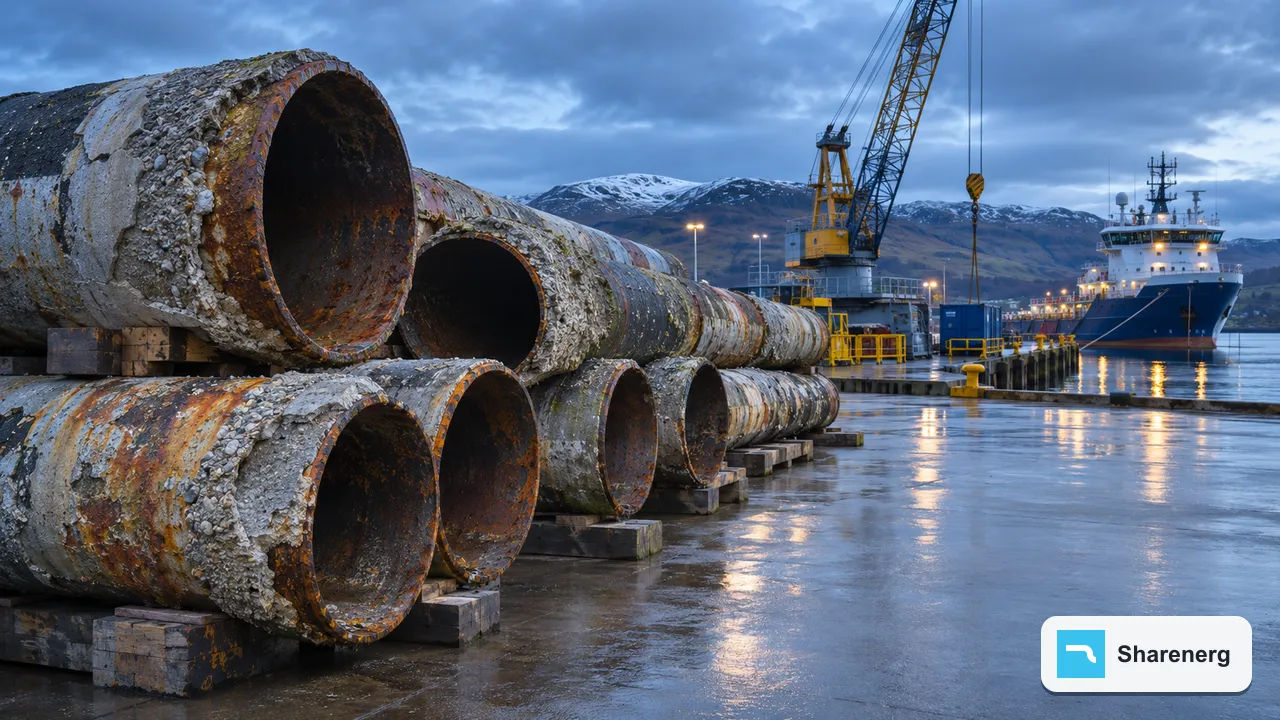
The North Sea Transition Authority (NSTA) estimates that finishing decommissioning on the UK Continental Shelf will cost £43.4 billion, according to its 2026 cost and performance update. Industry spent a record £2.6 billion on decommissioning in 2025. Pipelines are a smaller share of that bill than wells, but they raise some of the hardest decisions, because the choice between removing a line and leaving it buried in place has lasting consequences for the seabed, fishing and future reuse.
The 2026 numbers
The NSTA's UKCS Decommissioning Cost and Performance Update 2026, published on 13 August 2026, reports:
- an estimated £43.4 billion to complete the remaining decommissioning programme, down only slightly on the previous year;
- record spending of £2.6 billion in 2025;
- 71% of the value of decommissioning contracts awarded in 2025 going to UK-based organisations.
Wells have been the regulator's main focus in recent years, and the NSTA has publicly pressed operators over missed well decommissioning deadlines. Pipeline decommissioning tends to attract less attention, yet every field has export lines, infield flowlines, umbilicals, spools and protection structures that need a decision.
Who decides what happens to a pipeline
Decommissioning of offshore installations and pipelines is controlled through the Petroleum Act 1998. The GOV.UK guidance page, updated on 12 November 2026, explains that owners must submit a decommissioning programme listing all the equipment, infrastructure and materials installed, and the proposed solution for each item. The Offshore Petroleum Regulator for Environment and Decommissioning (OPRED) is responsible for making sure those requirements are met.
Draft programmes go out for comment from the public, non-governmental organisations and other bodies. Once work is complete, a close-out report records what was done. The guidance page lists close-out reports such as the Knarr gas pipeline (July 2025) and Brynhild pipeline (March 2024). A new fees regime for decommissioning functions took effect on 30 September 2026.
Remove or leave in place
For each pipeline, the owner prepares a comparative assessment that weighs options against criteria such as safety, environmental impact, technical feasibility, effect on other sea users and cost. The approved programmes listed by government show a consistent pattern:
- At Hewett, trenched and buried pipelines are to be left in situ, while surface-laid lines, exposed mattresses and grout bags are removed to shore.
- At Enoch, trenched and buried pipelines and an umbilical with more than 0.6 m depth of cover are to be decommissioned in situ, with exposed protection features brought ashore.
- At Otter, trenched and buried pipelines stay, while surface-laid pipelines, spools, jumpers and umbilicals are recovered.
The logic is practical. A line buried below the seabed poses little snagging risk to fishing gear and would cause significant disturbance if dug up. Lines lying on the surface, and the structures around them, are more likely to interfere with trawling and are easier to recover.
What leaving in place involves
Leaving a line in situ is not simply walking away. The pipeline is cleaned and flushed so that residual hydrocarbons and chemicals are removed to an agreed standard. Ends are cut and buried or covered, exposed sections and spans may be remediated with rock, and the owner remains responsible for monitoring. Seabeds move: sandwaves migrate and scour can uncover a line that was buried when it was laid. Our article on on-bottom stability explains why burial depth and seabed mobility matter through life, and the same factors apply after cessation of production.
What removal involves
Recovering a pipeline usually means cutting it into sections and lifting them, or reverse reeling for flexible lines and smaller rigid pipe. Concrete-coated pipe is heavy and can be degraded after decades on the seabed. Recovered material has to be handled onshore, with steel recycled where possible and contaminated material dealt with under waste rules.
Mattresses, umbilicals and protection structures
Pipelines rarely sit alone. Concrete mattresses, grout bags, rock berms, crossing supports and control umbilicals all form part of the inventory. The approved programmes listed above show that exposed protection items are usually brought ashore, while buried items may stay. Old mattresses can be fragile, with degraded ropes that make lifting difficult, so recovery methods such as frames or baskets are often planned to keep them intact during the lift.
Integrity data makes decisions easier
A comparative assessment is only as good as the information behind it. Operators with good records of burial depth, coating condition, internal corrosion and past inspections can make a confident case. Where data is poor, surveys have to be commissioned late in field life, adding cost. The approach set out in our article on digital twins and in-line inspection pays off here, because it keeps the information needed at the end of life up to date.
Reuse before decommissioning
Not every line has to be decommissioned straight away. Some existing pipelines are being considered for carbon dioxide transport or other new uses, as in the repurposed gas line that forms part of the HyNet CO2 network. A line that has been flushed, cut and buried is difficult to bring back, so the reuse question needs answering before a decommissioning programme is approved. Our article on designing CO2 pipelines sets out the checks an existing line would need to pass.
The same applies to storage. If the Rough storage site were to close, its wells and pipeline would enter the same decommissioning process, a point we cover in our article on Rough's future.
Lessons for engineers designing new lines
Decommissioning costs are being felt now on assets designed decades ago, when end of life was rarely considered. New pipelines, including CO2 and hydrogen lines, can be designed with that stage in mind: burial where practical, protection structures that are easy to recover, materials and coatings recorded clearly, and data systems that will still be readable in 30 years. Those choices cost little at the design stage and can save a great deal later.